


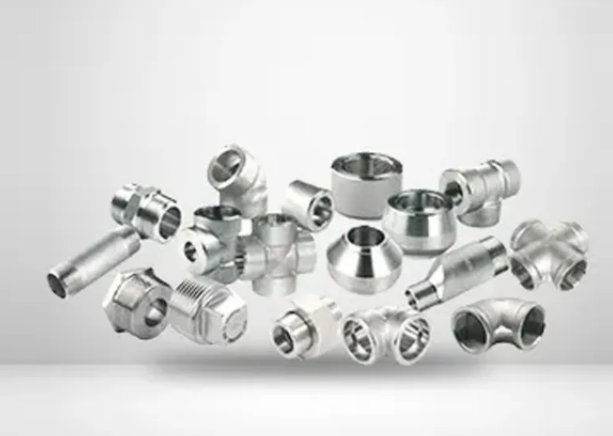
Differences in Manufacturing Processes of Different Types of Forged Fittings
Forged fittings are essential components in industrial piping systems, manufactured through various forging techniques that impart superior strength and durability. While all forged fittings share the commonality of being shaped through compressive forces, the specific manufacturing processes differ significantly depending on the type of fitting being produced. Understanding these differences is crucial for engineers, procurement specialists, and quality control professionals who need to select the right fittings for specific applications. This article explores the distinct manufacturing processes employed for different types of forged fittings, highlighting how each method contributes to the final product's characteristics.
The Fundamental Forging Process
Before examining the differences between fitting types, it is important to understand the core principles that underlie all forging processes. Forging involves shaping metal through compressive forces, typically applied after heating the material to a malleable state. The forging process refines the grain structure of the metal, eliminates internal voids, and enhances overall strength and toughness. There are four principal forging methods: smith forging, drop forging, press forging, and upset forging. Each of these methods is adapted to produce different types of fittings with specific geometries and performance requirements.
Manufacturing Process of Forged Elbows
Forged elbows are among the most complex fittings to manufacture due to their curved geometry and the need for uniform wall thickness throughout the bend. The manufacturing process for forged elbows typically begins with careful material selection, with carbon sTeel and alloy steel being the primary materials due to their excellent mechanical properties.
A specialized preparation process for forged elbows involves several distinct steps. First, a forged rod is punched to create a forged pipe, with careful control of eccentricity to ensure the finished elbow has uniform wall thickness. The eccentricity of the forged pipe is typically maintained at 4 to 6 percent of the wall thickness of the finished elbow. After heat treatment, the forged pipe is bent to form an elbow, utilizing the thinner semi-circular pipe wall as the inner ring and the thicker semi-circular pipe wall as the outer ring of the elbow. This technique ensures relatively uniform wall thickness between the inner and outer rings of the finished elbow.
The general manufacturing sequence for forged steel elbows includes: heating the steel to a malleable state, forming the elbow through hammering or pressing using a die, machining to achieve precise dimensions and surface finish, and final inspection to ensure compliance with industry standards. The forming step can be performed using either drop forging or press forging methods. Drop forging uses rapid impact forces to shape the metal, while press forging applies slower, more uniform pressure, resulting in higher dimensional accuracy.
For large diameter elbows, alternative methods such as the Monaka or double weld seam method may be employed. This technique involves symmetrically cutting two pieces of raw material tiles, then pushing and welding each pair to form the elbow shape. The hydraulic bulge method, which is a cold forming technique, and hot forming or extrusion methods are also used for certain elbow configurations.
Manufacturing Process of Forged Tees
Forged tees require a different manufacturing approach due to their three-branch geometry. The production of tees typically involves upset forging or extrusion methods to create the branch connection. In upset forging, a heated billet is compressed lengthwise, causing the metal to flow outward and form the lateral branch. This process requires precise control of temperature and pressure to ensure uniform material distribution across all three branches.
For equal tees, where all three branches have the same diameter, the forging process focuses on achieving balanced material flow to all three outlets. Reducing tees, which have one smaller branch, require additional die design considerations to manage the differential material flow. The manufacturing process must ensure that the branch junction maintains adequate wall thickness to withstand pressure stresses.
Manufacturing Process of Forged Couplings and Unions
Couplings and unions are simpler in geometry compared to elbows and tees, but their manufacturing processes still require precision to ensure reliable connections. Full couplings are typically manufactured through upset forging or extrusion, where a heated billet is formed into a hollow cylindrical shape with precise internal and external dimensions.
The manufacturing of couplings involves heating a metal billet to high temperature until it becomes malleable, then placing the heated metal in a die and shaping it using compressive forces. After forging, the fittings undergo machining to achieve precise dimensions and may be heat-treated for additional hardness. Half couplings, which have one closed end, require an additional forging step to form the solid end while maintaining the internal bore on the open end.
Unions consist of three separate components: a nut, a male end, and a female end. Each component is forged separately using different dies and then machined to create the precise threads and sealing surfaces required for proper assembly. The nut component requires specialized forging to create the hexagonal shape and internal threads, while the male and female ends require precise forming of their respective sealing faces.
Manufacturing Process of Forged Reducers
Reducers are designed to connect pipes of different diameters, and their manufacturing process focuses on achieving a smooth transition between two different cross-sections. Concentric reducers maintain a symmetrical axis, while eccentric reducers have an offset design to prevent liquid trapping or air accumulation.
The manufacturing of forged reducers typically involves hot extrusion or hot forming methods. In hot extrusion, a heated billet is pressed through the opening of a molded die to create the tapered shape. This process requires precise control of temperature and extrusion speed to ensure uniform wall thickness along the length of the reducer. For smaller sizes, reducers may also be produced through upset forging with specially designed dies that gradually transition from the larger diameter to the smaller diameter.
Manufacturing Process of Forged Caps and Plugs
Caps and plugs are used to seal pipe ends and are relatively simple in geometry, but their manufacturing processes still require careful attention to achieve reliable sealing.
Caps are typically manufactured through the deep drawing method or hot forming. In deep drawing, a flat metal blank is formed into a cup-like shape through progressive die stages, while hot forming involves pressing a heated billet into a die cavity that matches the cap's external profile.
Plugs are generally produced through upset forging or machining from bar stock. For threaded plugs, the forging process creates the basic shape, followed by machining to cut the external threads. The sealing surface of plugs requires particular attention during manufacturing to ensure leak-proof performance when installed.
Manufacturing Process of Forged Branch Outlets
Branch outlets, including Sockolets, Threadolets, and Weldoletes, are specialized fittings that require unique manufacturing processes. These fittings are designed to create branch connections from main piping runs and must withstand the stress concentration inherent at branch junctions.
The manufacturing of branch outlets typically involves hot extrusion or hot forming to create the distinctive shape that transitions from a flat base to a protruding branch neck. The base must be forged to match the curvature of the main pipe, requiring precise die design and careful control of the forging process. After forging, these fittings undergo extensive machining to create the internal bore and connection threads or weld preparation surfaces.
Heat Treatment and Post-Forging Processes
Regardless of the fitting type, most forged fittings undergo heat treatment processes after forging to enhance their mechanical properties. Common heat treatment processes include quenching and tempering, which improve strength and toughness. The specific heat treatment parameters depend on the material grade and the intended application of the fitting.
After heat treatment, all forged fittings undergo trimming and machining to achieve final dimensions and surface finish. Precision machining is essential for ensuring proper fit and sealing in piping systems. The final manufacturing stage involves rigorous inspection and testing, including pressure testing, dimensional checks, and sometimes non-destructive testing methods such as X-ray or ultrasonic inspection.
Differences in Forging Temperatures
Another significant difference in the manufacturing processes of various forged fittings lies in the forging temperature employed. Hot forging is conducted above the recrystallization temperature of the metal, typically between 1000°C and 1250°C for steel. This method is preferred for complex shapes like elbows and tees because the metal's high plasticity allows for greater deformation without cracking.
Warm forging is conducted at temperatures below the recrystallization temperature but above room temperature, typically between 700°C and 800°C. This method offers a balance between the advantages of hot and cold forging, providing good dimensional accuracy while reducing oxidation and decarburization.
Cold forging is performed at or near room temperature and is typically used for simpler fittings or for finishing operations. Cold forging produces excellent dimensional accuracy and surface finish but requires higher forming forces and is limited to materials with sufficient ductility.
Compliance with Manufacturing Standards
All forged fittings must comply with relevant industry standards that govern their manufacturing processes. The most important standard is ASME B16.11, which covers dimensions, tolerances, pressure-temperature ratings, material requirements, and markings for socket-weld and threaded forged fittings. Additional standards include MSS SP-79, SP-83, SP-95, and SP-97, which provide supplementary specifications for specific fitting types and testing requirements.
The manufacturing processes for different types of forged fittings vary significantly based on the complexity of the fitting geometry, the required mechanical properties, and the intended application. Elbows require specialized bending techniques to achieve uniform wall thickness, while tees demand careful management of material flow to three branches. Simpler fittings like couplings and caps can be produced through upset forging or deep drawing, while branch outlets require unique processes to create their distinctive shapes.
Each manufacturing method influences the final product's performance characteristics, including strength, durability, dimensional accuracy, and sealing capability. The selection of appropriate forging temperature, forming method, and post-forging treatments depends on the specific fitting type and its intended service conditions. Understanding these differences is essential for ensuring that forged fittings meet the demanding requirements of modern industrial piping systems, where safety, reliability, and longevity are paramount. Manufacturers must carefully control each stage of the process, from material selection through final inspection, to produce forged fittings that consistently meet the high standards required for critical applications across industries such as oil and gas, chemical processing, and power generation.
Largest manufacturing base for pipe fittings
A World Leading Pipe Fittings Manutacturer
Meeting and exceeding all your expectations

Address: No. 99, Baoying Street,Baoying County, Jiangsu Province, China
Tel: 0086-514-88290587 / 88989086
Mobile : 0086-18932365939
Contact Person:Tony Xu
E-mail: xqh@yz-huayu.com
Products
Butt-welded Fittings Forged Fittings Flanges PipesAbout
Company Profile Plant Area OverviewNews
Company News Industrial NewsContact
Contacts Online MessageKeep In Touch

© 2025 Yangzhou Huayu Pipe Fitting Co.,Ltd. All rights reserved | Powered by Yicheng Network | sitemap
This website uses cookies to ensure you get the best experience on our website.



 Phone
Comment
(0)