


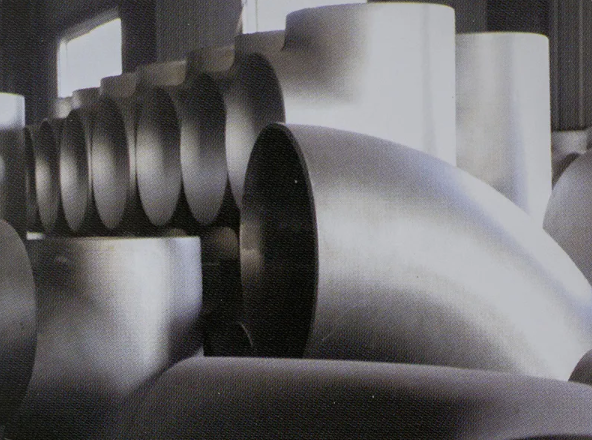
In the realm of piping systems across industries such as oil and gas, petrochemical, power generation, water treatment, and construction, butt-welded fittings play a pivotal role in connecting pipe sections, altering flow direction, branching lines, or changing pipe diameter. Unlike socket-weld or threaded fittings, which rely on fillet welds for joining, butt-welded fittings are designed to be welded directly onto the external surface of pipes with matching wall thicknesses, forming a continuous, smooth internal bore. This configuration minimizes turbulence, reduces pressure drop, and enhances structural integrity, making these fittings especially suitable for high-pressure, high-temperature, and critical service applications. Understanding the common types of butt-welded fittings involves exploring their geometry, functional purpose, and the engineering principles that govern their use in fluid transport networks.
1. Elbows – Changing Flow Direction
Elbows are among the most frequently used butt-welded fittings, serving to redirect the flow of media within a Pipeline. By introducing a curved path between two straight pipe segments, elbows allow pipelines to navigate around obstacles, change elevation, or align with equipment nozzles. The curvature is defined by its angle, with the most prevalent being the 45-degree and 90-degree elbows. A 45-degree elbow provides a gentle directional shift, reducing abrupt changes in flow velocity and minimizing pressure loss compared to a sharper turn. The 90-degree elbow facilitates a right-angle turn, essential for routing pipelines orthogonally in compact spaces.
Beyond standard angles, long-radius elbows feature a centerline radius equal to 1.5 times the pipe diameter, offering smoother flow transitions and lower frictional resistance than short-radius elbows, whose radius matches the pipe diameter. Long-radius designs are preferred in high-velocity or slurry services where erosion and turbulence must be minimized. Elbows may also be fabricated with reduced diameters to connect pipes of differing sizes while maintaining directional change, though concentric Reducers are often paired separately for more controlled flow adjustment. The welding ends of elbows are machined to match the outside contour of the pipe, ensuring full penetration and fusion during welding, which is vital for leak-tightness under pressure.
2. Tees – Creating Branch Connections
Tees are butt-welded fittings characterized by a T-shaped geometry, enabling the introduction of a branch line from a main pipeline. This configuration supports the distribution of fluids to multiple destinations or the integration of auxiliary systems into a primary flow path. Like elbows, tees come in various configurations based on diameter relationships. Equal tees have three openings of identical diameter, allowing uniform flow distribution between the main line and branch. Reducing tees feature a smaller diameter branch opening, facilitating connections between pipes of different sizes without requiring separate reducer fittings.
The orientation of the branch relative to the main line can influence flow dynamics; lateral tees direct the branch perpendicular to the main flow, while wyes (Y-shaped fittings) provide a gradual branch angle, typically 45 degrees, promoting smoother flow division and reducing turbulence. Although wyes are sometimes categorized separately due to their angled branch, they share functional similarities with tees in branching applications. Tees are engineered to maintain consistent wall thickness at all openings, preserving the mechanical strength of the pipeline system and preventing weak points at junctions. Precision machining of the weld ends ensures alignment with adjoining pipes, critical for achieving homogeneous weld beads and avoiding stress concentrations.
3. Reducers – Adjusting Pipe Diameter
Reducers address the need to transition between pipes of different diameters, either increasing or decreasing the bore size along the pipeline. Concentric reducers have a symmetrical, cone-like shape, with the centerline axis remaining aligned between the larger and smaller ends. This design maintains a central flow path, making it suitable for vertical pipelines or applications where symmetrical flow distribution is desired. Eccentric reducers, in contrast, feature an offset centerline, resulting in one side being parallel to the connecting pipe. This configuration prevents fluid accumulation in horizontal pipelines, particularly when joining pipes of different diameters in gravity-fed systems or when avoiding air pockets in liquid services.
Both concentric and eccentric reducers are manufactured with gradually changing wall thickness to match the connected pipes, ensuring seamless integration without abrupt changes in cross-sectional area that could induce flow separation or increased turbulence. The length of the reducer body is carefully proportioned to control the rate of diameter change, balancing space constraints with flow efficiency. In butt-welded installations, the reducer’s ends are beveled to match the pipe preparation, enabling full-penetration welds that sustain system pressure and prevent leaks.
4. Caps – Terminating Pipeline Runs
Caps serve as end closures for piping systems, providing a sealed termination to isolate the contained medium or mark the endpoint of a pipeline segment. These fittings are essential for pressure testing, future expansion planning, or isolating decommissioned sections. Butt-welded caps are typically hemispherical, elliptical, or flat in shape, each offering distinct mechanical and flow characteristics. Hemispherical caps distribute stress evenly and are favored in high-pressure applications due to their superior strength-to-weight ratio. Elliptical caps balance stress distribution with material economy, while flat caps are simpler to manufacture but require thicker walls to withstand pressure, making them less common in high-stress environments.
The interior surface of the cap is contoured to match the pipe bore, eliminating sharp edges that could cause turbulence or material buildup. Welding procedures for caps demand meticulous attention to heat input and weld profile to avoid warping the pipe end or creating inclusions. Properly installed caps ensure the pipeline remains pressure-tight and protected from external contaminants when not in service.
5. Stub Ends and Lap Joints – Facilitating Flexibility and Maintenance
Stub ends, often used in conjunction with lap joint Flanges, represent a specialized category of butt-welded fittings. A stub end is welded to the pipe, while a loose backing flange slides over the pipe and clamps onto the stub end’s raised face. This arrangement allows the flange to rotate freely, simplifying alignment during assembly, especially in large-diameter or hard-to-reach piping. It also enables easy replacement of the flange without cutting the pipe, enhancing maintenance flexibility. Although the stub end itself is butt-welded, the overall joint relies on both welding and bolted flange connections, blending the advantages of welded integrity with flanged adaptability.
6. Crosses – Multi-Branch Integration
Crosses, or four-way fittings, extend the functionality of tees by providing four connection points, allowing pipelines to branch in multiple directions from a single junction. They are commonly used in complex distribution networks, such as manifold systems, where several branch lines must intersect a main header. Like tees, crosses can be equal or reducing, depending on whether all openings or selected openings differ in diameter. The geometry of crosses requires careful consideration of flow interaction between branches to mitigate turbulence and pressure imbalances. Full-penetration butt welds at all four joints are critical to maintaining uniform strength and preventing leakage at multiple interfaces.
7. Laterals – Angled Multi-Port Connections
Laterals combine features of tees and elbows, featuring a branch connection at an angle to the main pipeline rather than perpendicular. This design is useful for directing flow into a branch that must follow a specific directional path dictated by spatial or process requirements. Laterals reduce the number of fittings needed in certain layouts, streamlining the system and potentially lowering pressure drop compared to using an elbow and tee in series. The angled branch introduces unique flow dynamics, necessitating precise engineering to ensure balanced flow distribution and minimize erosion at the junction.
Engineering Considerations Across Types
While each type of butt-welded fitting serves a distinct purpose, they share common engineering considerations that dictate their selection and application. Material compatibility is paramount; fittings must be manufactured from alloys that match or exceed the corrosion resistance and mechanical strength of the connected pipes, whether carbon steel, stainless steel, alloy steel, or non-ferrous metals. Dimensional accuracy, including outside diameter, wall thickness, and bevel angle, ensures proper fit-up and weld quality. Wall thickness must be sufficient to withstand internal pressure and external loads, with allowances for corrosion and erosion over the service life.
Welding procedures for butt-welded fittings require qualified operators, appropriate preheat and post-weld heat treatment where necessary, and rigorous inspection methods such as radiographic or ultrasonic testing to verify soundness. The smooth internal bore achieved through butt-welding reduces flow resistance and eliminates crevices where deposits or corrosion could initiate, contributing to system longevity and reliability.
The common types of butt-welded fittings—elbows, tees, reducers, caps, stub ends, crosses, and laterals—form the foundational vocabulary of piping design, enabling engineers to construct versatile, efficient, and robust fluid transport systems. Each type addresses specific geometric and functional challenges, from redirecting flow and branching lines to terminating runs and adjusting diameters. Their value lies not only in their individual capabilities but in their ability to integrate seamlessly into cohesive networks that meet the stringent demands of modern industry. Through careful selection, precision manufacturing, and expert welding practices, these fittings ensure that pipelines perform safely, efficiently, and reliably across a vast spectrum of applications.
Largest manufacturing base for pipe fittings
A World Leading Pipe Fittings Manutacturer
Meeting and exceeding all your expectations

Address: No. 99, Baoying Street,Baoying County, Jiangsu Province, China
Tel: 0086-514-88290587 / 88989086
Mobile : 0086-18932365939
Contact Person:Tony Xu
E-mail: xqh@yz-huayu.com
Products
Butt-welded Fittings Forged Fittings Flanges PipesAbout
Company Profile Plant Area OverviewNews
Company News Industrial NewsContact
Contacts Online MessageKeep In Touch

© 2025 Yangzhou Huayu Pipe Fitting Co.,Ltd. All rights reserved | Powered by Yicheng Network | sitemap
This website uses cookies to ensure you get the best experience on our website.



 Phone
Comment
(0)