


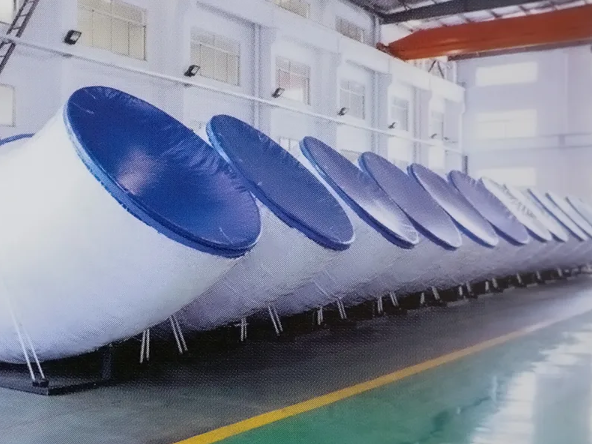
In modern fluid transport and pressure systems, the way components connect can determine not only the mechanical reliability of the installation but also its longevity and safety. Among the many types of pipe connectors—Flanged, threaded, socket-weld, and compression—the butt-welded pipe fitting holds a distinctive position. Characterized by a joining method that fuses fitting and pipe along a common plane, butt-welded fittings produce a continuous metallic pathway with no interruptions in the bore. This seamless integration makes them indispensable in situations where leak tightness, structural uniformity, and resistance to fatigue and corrosion are paramount. Their applications span a broad spectrum of industries, each with specific demands that butt-welding is uniquely suited to meet.
1. High-Pressure Systems: Ensuring Containment Under Stress
One of the primary domains of butt-welded fittings is high-pressure fluid and gas transport. In Pipelines carrying substances at elevated pressures—whether in power generation, chemical manufacturing, or offshore oil and gas production—any discontinuity in the flow path can become a locus of weakness. Threaded or flanged joints contain multiple potential leak paths: thread roots, gasket interfaces, and bolt holes. In contrast, a butt-weld creates a solid, homogeneous joint where the wall thickness of fitting and pipe remain consistent, allowing pressure forces to distribute evenly across the section.
Because the welding process effectively “becomes part of the pipe,” the joint’s pressure rating can closely match that of the parent material, subject to proper welding procedure and inspection. This enables designers to minimize the need for heavy wall thickness compensations at connections, leading to lighter, more economical systems without sacrificing safety. Furthermore, the smooth internal bore avoids turbulence and pressure drops caused by abrupt changes in geometry typical of some mechanical joints, supporting efficient flow in high-pressure networks.
2. Critical Fluid Transport: Zero-Leakage Requirements
In sectors where even minor leakage is unacceptable—such as handling hazardous fluids, high-purity gases, or sterile media—the uninterrupted internal surface of butt-welded fittings is a defining advantage. Pharmaceutical manufacturing, semiconductor fabrication, and food processing demand strict control over contamination risks. Flanged or threaded connections require gaskets, seals, or thread sealants, all of which represent potential ingress points for particulates, microbes, or chemicals.
A butt-weld eliminates these crevices and interfaces. Once completed and properly cleaned (for example, through pickling and passivation in stainless sTeel systems), the interior surface is as smooth and cleanable as the pipe itself. This characteristic supports compliance with cleanliness standards and facilitates validation processes in industries governed by stringent hygiene protocols. Additionally, the absence of protruding Fasteners or gasket edges reduces areas where deposits could accumulate, simplifying cleaning and maintenance.
3. Large-Diameter Piping Networks: Structural Uniformity and Economy
When pipe diameters grow beyond the practical limits of flanging or threading, butt-welded fittings become the natural choice. Forming reliable flanges on large-bore pipes involves considerable machining, bolting arrangements, and weight penalties. Threaded connections are generally impractical beyond small diameters due to the difficulty of cutting threads and the stress concentration they introduce.
Butt-welding offers a scalable solution: fittings such as Elbows, tees, Reducers, and Caps can be fabricated in matching diameters and joined by welding, preserving uniform mechanical properties across the assembly. This uniformity is particularly important in systems conveying high volumes of fluid, such as water distribution networks, district heating schemes, and bulk liquid transport in industrial complexes. The ability to prefabricate spools in workshop conditions and assemble them quickly on site also shortens construction schedules and reduces field labor.
4. High-Temperature Services: Thermal and Mechanical Compatibility
Applications involving elevated temperatures—such as steam lines in power plants, exhaust systems in marine propulsion, or furnace off-gas ducts—impose additional challenges on joints. Thermal expansion, cyclic loading, and the potential for creep deformation mean that joints must accommodate stress without becoming weak points.
Butt-welded joints, being integral with the pipe, respond to thermal changes in unison with the adjacent pipe sections, minimizing differential movement that could otherwise stress mechanical couplings. Properly selected filler materials and welding procedures ensure that the joint retains strength and ductility at service temperatures. Moreover, the lack of separate components like bolts or gaskets removes failure modes associated with relaxation of bolt tension or degradation of sealing elements in high-heat environments.
5. Corrosive and Aggressive Media: Seamless Protection
In pipelines transporting corrosive chemicals, the seamlessness of butt-welded fittings helps avoid crevice corrosion—a common issue at the interface of mechanical joints where stagnant microenvironments can develop. Because there are no gaps or discontinuities, the protective passive layers on corrosion-resistant alloys (such as stainless steels or nickel alloys) remain unbroken across the connection, preserving the material’s resistance throughout the system.
Furthermore, selecting matching alloy compositions for fittings and pipes ensures uniform electrochemical behavior, reducing the likelihood of galvanic corrosion at the joint. This holistic compatibility is especially relevant in chemical processing plants, wastewater treatment facilities, and desalination systems, where aggressive ions and pH extremes challenge the longevity of lesser connections.
6. Cryogenic Applications: Maintaining Toughness and Integrity
At extremely low temperatures, materials can become brittle and prone to fracture under stress. Mechanical joints in cryogenic lines must retain toughness and avoid leak paths that could allow ingress of moisture and subsequent ice formation. Butt-welded fittings made from cryogenic-grade materials (such as certain austenitic stainless steels or aluminum alloys) maintain ductile behavior at sub-zero conditions. The absence of gaskets or threaded interfaces removes components that could lose resilience or crack in the cold.
In liquefied gas storage and transport, where thermal contraction occurs uniformly along the length of pipe and fittings, the monolithic nature of butt-welded assemblies helps prevent stress concentrations that could initiate cracks. This contributes to the safe containment of cryogens used in energy, medical, and industrial applications.
7. Structural and Mechanical Support Functions
Beyond fluid conveyance, butt-welded fittings are employed where the pipe itself serves a structural role—such as in building frameworks, offshore platform risers, or support columns for industrial equipment. Here, the strength and stiffness of the welded joint are crucial because the fitting must transfer loads just as reliably as the straight pipe segments. Welding provides a bond that approaches the parent material’s mechanical properties, enabling predictable load paths and reducing the complexity of analysis compared with mechanically fastened joints.
8. Long-Term Installations and Minimal Maintenance Needs
Systems designed for decades of operation—such as municipal water mains, cross-country gas transmission lines, or permanent process plant piping—benefit from the minimal maintenance intrinsic to butt-welded construction. Without gaskets to replace, bolts to retighten, or threads to reseal, the long-term inspection regime focuses on monitoring material condition rather than joint integrity. This translates into lower lifecycle costs and higher availability, especially in inaccessible locations such as underground, underwater, or within machinery enclosures.
The application scenarios for butt-welded pipe fittings are united by a common thread: the need for a joint that is as strong, continuous, and reliable as the pipe itself. From high-pressure containment and zero-leakage purity systems to large-diameter networks, high-temperature and cryogenic services, corrosive media handling, and structural roles, butt-welding delivers a solution that mechanical connections struggle to match. Its seamless design, combined with adaptability to diverse materials and sizes, makes it a cornerstone technology in constructing safe, durable, and efficient fluid transport infrastructures across virtually every sector of modern industry.
Largest manufacturing base for pipe fittings
A World Leading Pipe Fittings Manutacturer
Meeting and exceeding all your expectations

Address: No. 99, Baoying Street,Baoying County, Jiangsu Province, China
Tel: 0086-514-88290587 / 88989086
Mobile : 0086-18932365939
Contact Person:Tony Xu
E-mail: xqh@yz-huayu.com
Products
Butt-welded Fittings Forged Fittings Flanges PipesAbout
Company Profile Plant Area OverviewNews
Company News Industrial NewsContact
Contacts Online MessageKeep In Touch

© 2025 Yangzhou Huayu Pipe Fitting Co.,Ltd. All rights reserved | Powered by Yicheng Network | sitemap
This website uses cookies to ensure you get the best experience on our website.



 Phone
Comment
(0)