


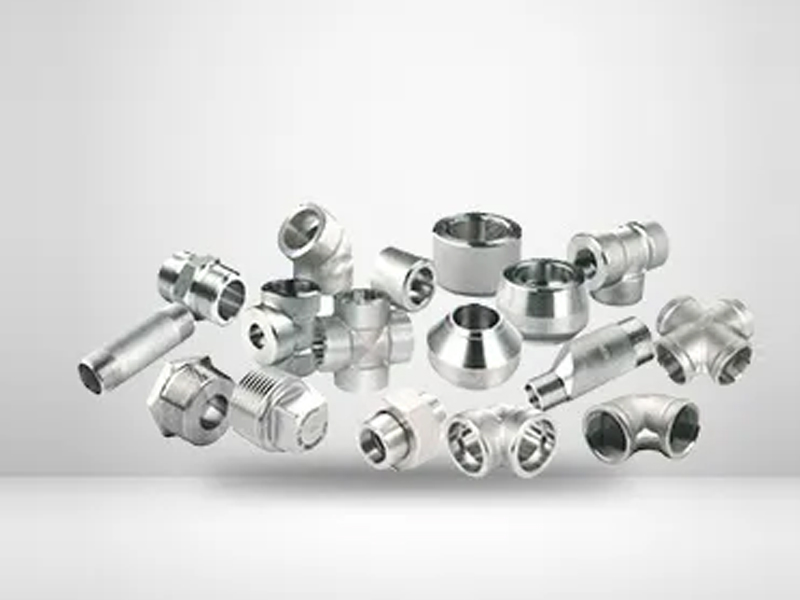
Forged Fittings play a pivotal role in fluid transport and pressure systems, serving as compact, high-integrity connectors that join pipes, valves, and equipment. Unlike fittings formed by casting or machining from plate or bar stock, forged fittings derive their structure from the compressive working of heated metal, which refines grain structure, enhances mechanical uniformity, and reduces porosity. This manufacturing route endows them with superior strength, impact resistance, and fatigue performance, making them ideal for demanding applications. However, the advantages of forging can only be fully realized when the material selection aligns precisely with the service environment, mechanical loads, and operational requirements. Choosing the right material for forged fittings is thus a multifaceted decision that integrates metallurgical knowledge, corrosion science, and engineering judgment.
1. Understanding the Nature of Forging and Its Influence on Material Properties
Forging subjects metal to compressive forces at elevated temperatures, causing plastic deformation that closes internal voids, aligns grain flow along the shape of the part, and improves mechanical homogeneity. Compared with castings, forgings exhibit fewer inclusions and less segregation; compared with machined parts from wrought stock, they often display enhanced directional strength due to grain orientation. These characteristics make forged fittings especially suitable for high-pressure, high-cycle, or shock-load environments.
Nevertheless, the benefits hinge on choosing a material whose metallurgical behavior is compatible with the forging process and the intended service. Not all alloys forge equally: some are prone to cracking during deformation, others may undergo undesirable phase transformations, and still others may lose corrosion resistance if improperly processed. Therefore, material selection begins with understanding how the alloy responds to forging temperatures, strain rates, and cooling practices.
2. Matching Material Class to Operating Environment
Metallic Families Commonly Used in Forged Fittings
The principal materials for forged fittings fall into several families, each offering a distinct set of attributes:
Carbon and Low-Alloy STeels: These are widely used for general-purpose fittings where high strength and toughness are required at moderate cost. Carbon steels provide good mechanical properties but limited corrosion resistance; low-alloy steels add elements such as chromium, molybdenum, or nickel to improve hardenability, strength, and resistance to creep or thermal fatigue. They are common in oil and gas, power generation, and industrial fluid systems operating at ambient or moderately elevated temperatures.
Stainless Steels: Chosen primarily for corrosion resistance, stainless steels are classified into several groups. Austenitic grades (e.g., 304, 316) offer excellent resistance to oxidizing environments and good ductility, making them suitable for chemical, food, pharmaceutical, and marine applications. Ferritic and martensitic grades provide higher strength and magnetic properties but lower corrosion resistance and weldability. Duplex stainless steels combine high strength with superior chloride resistance, advantageous in aggressive aqueous environments.
Nickel Alloys: These materials excel in extreme conditions involving high temperatures, strong reducing acids, or mixed corrosive-oxidizing media. Nickel alloys retain strength and toughness over wide temperature ranges and resist stress-corrosion cracking where steels and stainless steels may fail. They are favored in chemical processing, aerospace, and specialized energy systems.
Copper Alloys and Aluminum Alloys: Selected mainly where thermal or electrical conductivity is needed alongside adequate corrosion resistance. Copper alloys suit potable water and certain marine applications, while aluminum alloys serve lightweight, corrosion-prone environments such as cryogenics and certain architectural systems.
The first step in selection is to map the service environment—chemical composition of the conveyed medium, temperature range, pressure, and potential presence of mechanical or thermal cycling—to the corrosion and strength profiles of these alloy families.
3. Considering Pressure and Mechanical Load Requirements
Forged fittings are often employed in high-pressure systems where joint integrity is critical. The mechanical properties that matter include tensile strength, yield strength, hardness, and impact toughness. In high-pressure gas or liquid service, the fitting must withstand hoop and longitudinal stresses without undergoing plastic deformation or brittle failure.
Material strength is influenced by both composition and heat treatment. Low-alloy steels can be quenched and tempered to achieve high yield strengths, while stainless steels rely on solid-solution strengthening and work hardening. Nickel alloys obtain strength from solid-solution effects and, in some cases, precipitation hardening. The selected material must meet or exceed the pressure rating of the system, accounting for wall thickness, fitting geometry, and safety factors mandated by codes and standards.
Additionally, fatigue resistance is vital in systems with pulsating flows or frequent pressure cycling. Fine grain size resulting from proper forging and heat treatment enhances fatigue life. Some nickel alloys and certain stainless steels exhibit exceptional fatigue endurance, making them preferable where vibration or cyclic loading is significant.
4. Corrosion Resistance and Chemical Compatibility
The resistance of a forged fitting to the service environment depends on the alloy’s ability to form and maintain a protective surface film, resist specific types of attack (pitting, crevice, intergranular, stress-corrosion cracking), and withstand temperature-induced changes in corrosion behavior.
For instance, in chloride-laden aqueous environments, austenitic stainless steels with molybdenum additions (e.g., 316, 316L) demonstrate improved pitting and crevice corrosion resistance compared with basic 304 stainless steel. In more aggressive chloride conditions or at elevated temperatures, duplex or super duplex stainless steels offer higher pitting resistance equivalent numbers (PREN) and better resistance to stress-corrosion cracking.
If the environment contains reducing acids (hydrochloric, sulfuric at low pH) or mixed oxidizers and reductants, nickel alloys become advantageous due to their stability across broad electrochemical conditions. In high-temperature oxidizing atmospheres, alloys with significant chromium and aluminum content can form adherent oxide scales that protect against scaling and metal loss.
It is essential to match the fitting material’s corrosion resistance to that of the adjoining pipe and components to avoid galvanic corrosion. Using the same alloy family throughout the system minimizes electrochemical potential differences. If dissimilar metals must be joined, suitable insulation or coating strategies should be employed.
5. Weldability and Fabrication Considerations
Many forged fittings will be integrated into systems that require welding, either during initial installation or future modifications. The weldability of the chosen material affects ease of fabrication, the risk of introducing defects, and the corrosion resistance of the weld zone.
Carbon steels and most austenitic stainless steels are readily weldable, but care must be taken to avoid issues such as hardening in carbon steels (manageable with preheat and post-weld heat treatment) or sensitization in stainless steels (mitigated by using low-carbon grades like 304L or 316L). Duplex stainless steels require controlled heat input to preserve phase balance. Nickel alloys are generally weldable but demand protection from contaminants during heating to prevent embrittlement.
Since forging already imparts favorable grain structure, the heat-affected zone in welding can often return to acceptable properties if proper procedures are followed. Nonetheless, the filler metal selection and welding technique must be tailored to the base material to ensure joint integrity.
6. Temperature Extremes and Material Stability
Service temperature profoundly influences material selection. At cryogenic temperatures, some materials become brittle; austenitic stainless steels and certain nickel alloys retain toughness, making them suitable for liquefied gas handling. At high temperatures, strength and oxidation resistance become critical—low-alloy steels may suffer from creep, while stainless steels and nickel alloys are chosen for their elevated-temperature stability.
Thermal expansion coefficients should also be considered in systems experiencing wide temperature swings; mismatched expansions between fitting and pipe can induce thermal stresses. Selecting materials with similar expansion characteristics helps reduce this risk.
7. Regulatory and Code Compliance
Various industries adhere to standards that dictate permissible materials for pressure-retaining components. These codes specify required mechanical properties, testing methods, and sometimes mandate particular alloy compositions for certain services (e.g., nuclear, potable water, hydrocarbons). Ensuring that the selected forged fitting material complies with relevant standards is not only a matter of technical suitability but also of legal and insurance compliance.
8. Life-Cycle Perspective and Economic Balance
While high-performance alloys offer superior corrosion and temperature resistance, they carry higher initial costs. A comprehensive selection process weighs upfront price against expected service life, maintenance needs, and risk mitigation. In aggressive environments, investing in a more corrosion-resistant alloy can reduce downtime, inspection frequency, and replacement costs, yielding lower total cost of ownership.
Selecting the material for forged fittings is a systematic process that goes beyond simply matching mechanical strength to pressure requirements. It demands a deep understanding of the service environment, corrosion mechanisms, mechanical loading, forging characteristics, weldability, and regulatory constraints. By aligning alloy composition and properties with these factors, engineers can ensure that forged fittings provide the reliability, safety, and longevity demanded by critical fluid transport systems across industries—from power generation and chemical processing to marine and cryogenic applications. The result is a robust integration of metallurgical insight and practical engineering, turning a fundamental component into a cornerstone of system integrity.
Largest manufacturing base for pipe fittings
A World Leading Pipe Fittings Manutacturer
Meeting and exceeding all your expectations

Address: No. 99, Baoying Street,Baoying County, Jiangsu Province, China
Tel: 0086-514-88290587 / 88989086
Mobile : 0086-18932365939
Contact Person:Tony Xu
E-mail: xqh@yz-huayu.com
Products
Butt-welded Fittings Forged Fittings Flanges PipesAbout
Company Profile Plant Area OverviewNews
Company News Industrial NewsContact
Contacts Online MessageKeep In Touch

© 2025 Yangzhou Huayu Pipe Fitting Co.,Ltd. All rights reserved | Powered by Yicheng Network | sitemap
This website uses cookies to ensure you get the best experience on our website.



 Phone
Comment
(0)